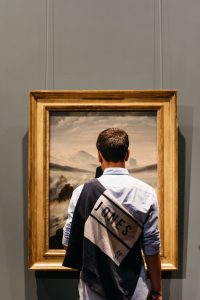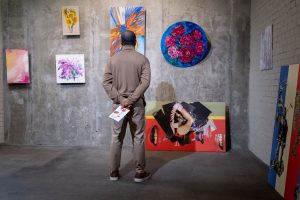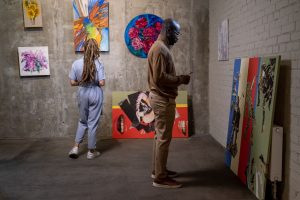
There is an ongoing argument about art that never quite resolves. Walk into a major contemporary art museum and you will hear versions of it everywhere. Someone standing before a canvas of apparent emptiness says they do not understand it, that their child could have made it, that it does not belong in a museum next to Rembrandt. Someone else standing before the same canvas is moved in a way they struggle to articulate, feeling something about the color, the scale, the intention, the silence of it, that connects to something real in their interior life.
This argument is not a sign that something is wrong with contemporary Western art. It is a sign that something is right. Art worth arguing about is art that is doing something, that is pressing on questions about meaning, value, beauty, identity, and reality that do not have easy answers and that different people experience from different positions. The fact that contemporary Western art generates such debate is evidence of its cultural vitality, not its failure.
What Contemporary Western Art Actually Means as a Category
Before examining the substance of contemporary Western art, it is worth being precise about what the category actually encompasses, because both terms in the phrase carry significant definitional weight that shapes what we are discussing.
Contemporary art, in the most common curatorial and critical usage, refers to art made from roughly the 1960s or 1970s to the present day. Some institutions use 1945, the end of World War II, as a starting point, while others use 1970 or even 1989, the fall of the Berlin Wall, as a more culturally coherent beginning. The imprecision is not a failure of definition. It reflects the genuine difficulty of identifying a clean temporal boundary in a field where movements, ideas, and influences flow continuously across supposed historical thresholds.
Western art refers to the art traditions originating in and primarily associated with Europe and its colonial and cultural offshoots, including North America, Australia, and the broader sphere of cultural influence that European civilization established through centuries of expansion and institutional dominance. This geographic and cultural designation is itself a contested and increasingly complicated category, as contemporary Western art has engaged deeply with questions about whose stories get told, whose aesthetics are centered, and whose histories are recognized in the institutional frameworks of museums, galleries, art markets, and criticism.
The intersection of these two terms produces a category that is simultaneously vast and specific. Contemporary Western art includes the major movements that followed Abstract Expressionism, from Pop Art through Minimalism, Conceptualism, Postmodernism, Identity Art, and into the genuinely plural, category-resistant landscape of the present moment. It includes painting, sculpture, installation, performance, video, digital media, photography, and hybrid practices that resist medium classification. And it increasingly includes the work of artists from non-Western backgrounds operating within Western institutional frameworks, whose presence has transformed what Western art means and who gets to define it.
Why the Term Contemporary Western Art Is Contested
The very phrase contemporary Western art carries a historical weight that contemporary artists and critics are acutely aware of. The centering of Western traditions in global art discourse, the presumption that Western aesthetic categories are universal or neutral, and the historical exclusion of non-European artists and perspectives from the canon of serious art history are all dimensions of a broader critique that has been one of the most productive and transformative forces in contemporary art over the past five decades.
The Historical Threads That Lead to the Contemporary Moment
Contemporary Western art does not exist in historical isolation. It is a response to, a continuation of, and in many cases a deliberate rupture from the artistic traditions that preceded it. Understanding the historical threads that lead to the contemporary moment is essential for understanding why contemporary art looks and behaves the way it does.
The most significant historical event shaping contemporary Western art is World War II and its aftermath. The war’s unprecedented scale of destruction, the revelation of the Holocaust, the development and use of atomic weapons, and the subsequent Cold War created a cultural environment in which the optimistic humanist assumptions underlying much earlier Western art felt deeply, even lethally, naïve. How could figurative painting in the classical tradition continue after Auschwitz? How could the celebration of Western civilization’s achievements continue after Hiroshima? These questions were not merely rhetorical. They drove genuine artistic crisis and produced genuine artistic transformation.
Abstract Expressionism, the movement most commonly identified as the starting point of the postwar art world, was the American art world’s answer to this crisis. Painters including Jackson Pollock, Mark Rothko, Willem de Kooning, and Franz Kline developed approaches to painting that abandoned representation, narrative, and the traditional hierarchies of subject matter in favor of direct, physical engagement with paint as a material and with the act of painting as itself expressive. The scale, the physical energy, the apparent rawness of Abstract Expressionist work was understood by its practitioners and by the critics who championed it as a genuine response to historical rupture, a new beginning for painting that did not depend on the compromised traditions of European representational art.
The Movements That Defined the Postwar Decades
What followed Abstract Expressionism was not a single coherent development but a rapid, often contradictory proliferation of movements, each responding to or reacting against its predecessors in ways that illuminate the internal logic of the contemporary art world as a field of ongoing argument rather than linear progress.
Pop Art in the late 1950s and early 1960s, associated with Andy Warhol, Roy Lichtenstein, and in Britain with Richard Hamilton and Eduardo Paolozzi, turned the earnestness of Abstract Expressionism inside out by embracing the imagery, aesthetics, and cultural logic of mass consumer society. Soup cans, celebrity photographs, comic strips, and advertising imagery became the materials of serious art, a move that was simultaneously a celebration of popular culture, a critique of fine art’s pretensions to transcendence, and a prescient commentary on the emerging culture of image reproduction and consumption that would come to define late capitalism.
Minimalism in the 1960s, associated with Donald Judd, Robert Morris, Dan Flavin, and Carl Andre, stripped art down to its most fundamental material conditions, rejecting illusion, representation, expression, and metaphor in favor of literal objects in literal space. A grid of bricks on a gallery floor, fluorescent tubes arranged in geometric configurations, identical steel boxes arranged in rows, these were not symbols of anything beyond themselves. They insisted on their own physical reality and on the viewer’s physical relationship to them in space, a radical democratization of artistic meaning that dispensed with the intermediary of interpretation in favor of direct perceptual experience.
The Major Themes Shaping Contemporary Western Art Today
The contemporary art world of the present moment is characterized not by a dominant movement or style but by a genuinely plural landscape in which multiple conversations are happening simultaneously, often in dialogue with each other and often across significant disagreements about what art is for, what it should look like, and whose experiences it should reflect.
Identity and representation have been among the most productive and contested themes in contemporary Western art for the past several decades. The feminist art movement, which gained institutional traction in the 1970s and continues to reshape art history and contemporary practice, challenged the systematic exclusion of women artists from the canon and the male-centered assumptions embedded in Western representational traditions. Artists including Judy Chicago, Barbara Kruger, Cindy Sherman, and Kara Walker have each engaged with these questions in ways that are visually powerful, critically sophisticated, and culturally transformative.
Questions of race, colonialism, and cultural identity have been equally central. Artists including Jean-Michel Basquiat, who died tragically young but whose work remains among the most culturally significant of the late twentieth century, addressed the experience of Black identity in a white-dominated art world and society with an urgency and visual intelligence that has only grown in cultural resonance since his death. Artists including Kara Walker, Kerry James Marshall, and Theaster Gates have continued to develop richly complex practices that engage with African American history, experience, and aesthetic traditions in ways that have significantly expanded the range of what American art can be and do.
Technology, the Digital World, and New Forms of Practice
The relationship between contemporary Western art and technology has intensified dramatically over the past three decades, producing genuinely new forms of practice that do not simply use digital tools to make more traditional art but that explore the specific properties of digital media as themselves artistically and culturally significant.
Video art, which began in the late 1960s with artists like Nam June Paik, has evolved into one of the most significant mediums in contemporary practice. Artists including Bill Viola, whose large-scale video installations create immersive experiences of extraordinary emotional and spiritual depth, and Hito Steyerl, whose essay films and installations engage with the political economy of images in the digital age with brilliant conceptual rigor, represent the extraordinary range of what video and moving image art can accomplish.
The Cultural Significance of Contemporary Western Art Beyond the Gallery
Contemporary Western art’s cultural significance extends well beyond the walls of museums and galleries, influencing and being influenced by popular culture, politics, public space, and the broader visual environment in ways that are often invisible precisely because they are so pervasive.
Street art and graffiti, once regarded as criminal defacement, have been integrated into the mainstream art world through the extraordinary success of artists like Banksy, whose anonymous, politically charged interventions in public spaces around the world have reached audiences of hundreds of millions and whose work commands significant auction prices. This integration has been celebrated as the democratization of art and critiqued as the co-optation of a genuinely anti-institutional practice into the very institutional structures it was designed to challenge. Both assessments contain truth, and the productive tension between them is itself culturally significant.
Art Markets and the Financialization of Contemporary Art
The art market, which has grown dramatically since the 1980s, represents another dimension of contemporary Western art’s cultural significance that deserves serious attention. The transformation of contemporary art into a significant asset class, with works by living artists selling for tens and hundreds of millions of dollars at auction, has created economic structures that both support and distort artistic production.
Final Thoughts
Contemporary Western art is a living argument, as the opening of this essay suggested, and arguments are how cultures think through their most important questions. The argument about what art is, who gets to make it, what it should look like, whose experiences it should reflect, and what it is for, is not separate from the cultural arguments about identity, power, history, and value that define the present historical moment. It is one of those arguments, conducted in visual form with tools of extraordinary sophistication and range.
To engage seriously with contemporary Western art is to engage seriously with the questions that most matter about the kind of civilization we are building and the kind of human beings we are becoming. It requires patience, intellectual humility, and the willingness to be genuinely unsettled by what you see. It requires accepting that confusion is not failure but often the beginning of genuine understanding.