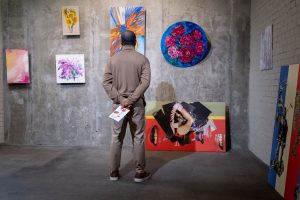
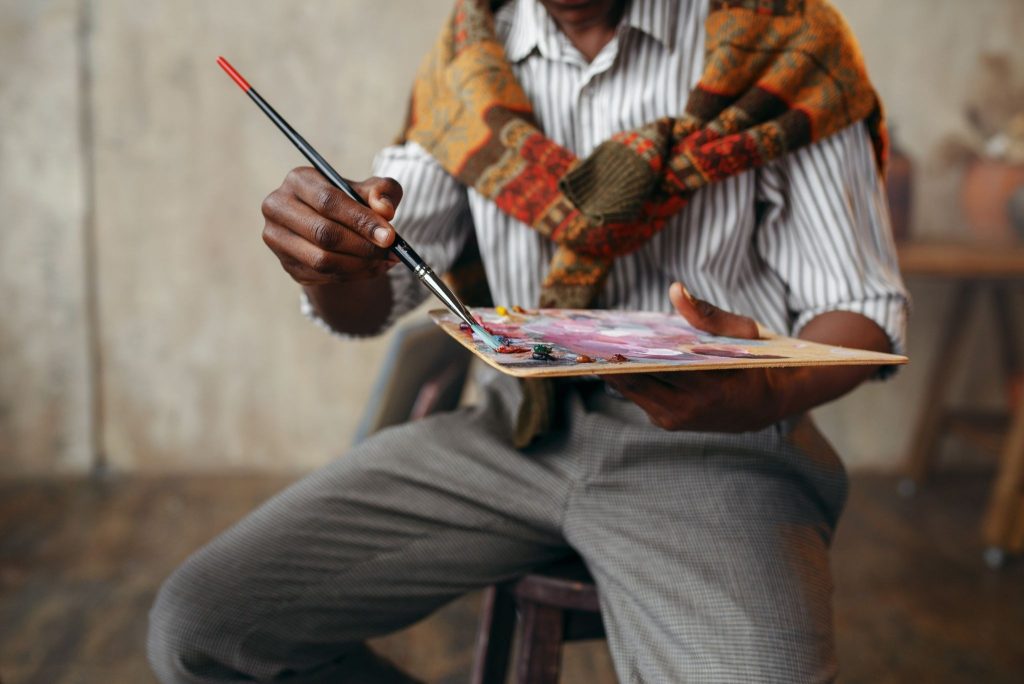
There is something that happens when you learn the story behind a piece of art that has moved you. The painting or sculpture or installation that already affected you becomes something different when you understand who made it, what their life was like, what they were running from or running toward when they made it. The object does not change. But your relationship to it deepens in ways that are difficult to articulate and impossible to forget.
This is why contemporary artist biographies matter. Not as celebrity gossip or art world intrigue, though there is plenty of both to sustain the curious. But as a way of understanding art as a human practice, as the product of specific lives lived in specific historical moments under specific pressures and with specific gifts. The greatest contemporary artists are not simply producers of aesthetically significant objects. They are people who found ways to metabolize their experience, their culture, their fears and desires, into visual form that speaks to others across distance and difference.
Why Artist Biographies Matter for Understanding Contemporary Art
The relationship between biography and artistic meaning is one of the oldest debates in art theory and criticism. The formalist tradition, associated in the twentieth century with critics like Clement Greenberg, argued that the proper object of art criticism was the work itself, its formal properties, its relationship to other works and to the history of the medium, entirely independent of the biographical circumstances of its maker. Knowing that Jackson Pollock was an alcoholic, on this view, tells you nothing about the significance of his drip paintings as paintings.
The counter-argument, and the one that has gained considerable ground in contemporary art discourse, is that artworks are not autonomous formal objects but communicative acts embedded in specific human and historical contexts, and that understanding those contexts enriches rather than reduces the experience of the work. This does not mean reducing art to autobiography or collapsing the distinction between the person and the work. It means recognizing that the choices an artist makes, what they paint, how they paint it, what they choose to address and what they choose to ignore, are always choices made by a specific person with a specific history, and that knowing something about that history allows a deeper reading of the choices.
Contemporary art is particularly susceptible to biographical interpretation because so much of it is explicitly autobiographical in its concerns. Artists including Tracey Emin, who has built an entire career on direct autobiographical disclosure, and Kara Walker, whose work addresses the history of slavery through lenses that include personal identification and inherited cultural trauma, make work where the biographical context is not incidental but structural. Understanding who these artists are, where they came from, what they have experienced, and what they are responding to is not a supplement to understanding the work. It is part of the work itself.
How Creative Journeys Reveal the Conditions of Artistic Production
Beyond individual biography, the creative journeys of contemporary artists reveal the structural conditions under which art is produced, the institutional gatekeepers, the market forces, the questions of access and exclusion, and the role of chance, mentorship, and timing that shape who becomes a recognized artist and what kinds of work get made and seen.
The creative journey of Jean-Michel Basquiat, for example, is not just the story of a remarkably gifted individual. It is the story of a young Black man from Brooklyn navigating an art world that was simultaneously fascinated by and resistant to his presence, of how the proximity to Andy Warhol both accelerated his market success and complicated his artistic development, and of how the pressures of sudden extreme fame at a young age contributed to the circumstances of his death at twenty-seven. His biography illuminates not just his own art but the dynamics of race, class, and cultural appropriation in the New York art world of the 1980s in ways that are still relevant to understanding that world today.
Selected Contemporary Artist Biographies: Lives That Illuminate the Work
Rather than attempting a comprehensive survey of contemporary artist biographies, which would require multiple volumes, this section explores a selection of artists whose creative journeys are particularly illuminating, both for understanding their own work and for understanding broader dynamics in contemporary art.
Kara Walker: History, Race, and the Art of Uncomfortable Confrontation
Kara Walker was born in 1969 in Stockton, California, and grew up in Atlanta, Georgia, after her family moved south when she was thirteen. This move from a predominantly Black neighborhood in California to the Atlanta suburbs, where she suddenly found herself in a white-majority environment encountering the social dynamics of the American South, was a formative experience that shaped her artistic concerns in ways she has discussed extensively in interviews.
Walker attended the Atlanta College of Art and then the Rhode Island School of Design, where she developed the silhouette technique that would become her signature. The silhouette, with its long history in European portraiture and decorative art as a respectable bourgeois form, became in Walker’s hands a vehicle for depicting scenes of slavery, racial violence, sexual exploitation, and the complex, often perverse power dynamics of the antebellum American South with a directness and unflinching explicitness that shocked the art world when she first exhibited the work in the mid-1990s.
The controversy that greeted her early work was intense and revealing. Some prominent African American artists and critics, including Betye Saar, argued that Walker’s imagery was exploitative of Black suffering and played into white voyeuristic fantasies about slavery. Walker’s response to this criticism, which she has engaged with rather than dismissed, has been to continue making the work while articulating the complex intentionality behind it. Her position is that the discomfort her work produces is the point, that sanitizing or aestheticizing the history of American slavery is its own form of violence, and that the silhouette form’s elegant historical associations make the contrast with its content all the more productive as a critical tool.
Walker’s creative journey has continued to develop across decades, expanding from wall-based silhouette installations to sculpture, drawing, video, and in 2014, the monumental sugar sphinx A Subtlety, installed in a former sugar refinery in Brooklyn. This work, with its massive scale and its explicit engagement with the history of sugar production and the enslaved labor that supported it, demonstrated that Walker’s practice had grown in ambition and scope while remaining consistent in its unflinching engagement with the histories that American culture most prefers to forget.
Ai Weiwei: Art as Resistance and the Biographical Stakes of Dissent
No contemporary artist biography illustrates more dramatically the relationship between personal life and artistic practice than that of Ai Weiwei, the Chinese artist, activist, and public intellectual whose work has made him one of the most internationally recognized artists of his generation and, for a period, one of the most dangerous positions to occupy in contemporary Chinese public life.
Ai Weiwei was born in Beijing in 1957, the son of Ai Qing, one of China’s most celebrated poets. When Ai Weiwei was one year old, his father was declared a rightist during the Anti-Rightist Campaign and the family was sent to a labor camp in the remote northwest, where they lived for five years. The family returned to Beijing but were sent again, to Xinjiang, in 1967 during the Cultural Revolution, remaining there until 1976. These formative experiences of political persecution and enforced displacement, of watching a celebrated intellectual reduced by political machinery to shoveling excrement, shaped Ai Weiwei’s relationship to authority and to art in ways that are visible throughout his career.
His time in New York from 1981 to 1993, where he encountered the work of Marcel Duchamp, Andy Warhol, and Jasper Johns, provided the conceptual framework for a practice that would later deploy the provocations of Dada and Pop Art against very different political targets. Returning to China in 1993 to care for his ailing father, he became increasingly active as an architect, blogger, and cultural commentator, and his collaboration on the Beijing National Stadium for the 2008 Olympics was followed almost immediately by his public criticism of the Games and of the Chinese government, marking a turning point in his relationship to the state.
His seventy-one-day detention without charge in 2011, following years of escalating confrontation with Chinese authorities including the demolition of his Shanghai studio, was a biographical event that became itself the material of art. The documentation of his detention, the international response to it, and the subsequent legal and financial harassment he experienced generated work including the installation he made after his release documenting the conditions of his captivity. His biography is, in the most direct possible sense, indistinguishable from his art.
Cindy Sherman: Identity, Performance, and the Art of Self-Disappearance
Cindy Sherman’s creative journey represents a different kind of biographical engagement with art, one in which the artist’s personal biography is deliberately withheld rather than disclosed, and the self is used as a material to be transformed rather than expressed. Sherman has worked since the late 1970s with a single deceptively simple practice: photographing herself in character, in costume, as a vast array of fictional personages that range from anonymous film noir heroines to old masters portraits to fashion victims to horror movie ingénues.
Born in 1954 in Glen Ridge, New Jersey, Sherman studied art at Buffalo State College, where she encountered the Pictures Generation, a group of artists who were critically examining the mass media’s construction of identity, particularly female identity, through the use of appropriated and staged imagery. Her Untitled Film Stills series, begun in 1977, placed her almost instantly at the center of one of the most significant intellectual conversations in contemporary art: the question of how women are represented in visual culture and what it means to inhabit, perform, or critique those representations from the inside.
Common Threads in Contemporary Artist Creative Journeys
Across the enormous diversity of contemporary artist biographies, certain common threads emerge that reveal something about the conditions under which significant art is made and about the kinds of experience that tend to generate the most powerful artistic responses.
Marginality and the experience of being positioned outside the dominant culture is perhaps the most consistent theme across contemporary artist biographies of significance. Basquiat as a Black man in a white-dominated art world, Walker as a woman making work about Black history, Ai Weiwei as a dissident in an authoritarian state, Sherman as a woman interrogating the male gaze, all of these artists produced their most significant work from positions that were in some sense marginal to the centers of cultural power. This is not a romantic cliché about the suffering artist. It is an observation about the relationship between distance and perspective, the way that inhabiting a marginal position relative to dominant culture creates the critical angle of vision that enables genuine insight.
Final Thoughts
Contemporary artist biographies are not supplementary materials to the main event of the art itself. They are the human context without which the art is legible but not fully known, understandable but not fully felt. The creative journeys of the artists who have shaped contemporary art, with their contradictions, their struggles, their moments of devastating failure and quiet breakthrough, their engagement with history and personal experience and the specific texture of the cultures they inhabited, are themselves stories worth telling and worth knowing.
Understanding that Kara Walker’s silhouettes come from her experience of moving from California to the American South as a young woman, that Ai Weiwei’s political confrontations are rooted in a childhood spent in state-enforced labor camps, that Cindy Sherman’s lifelong project of self-disappearance in character is a sustained investigation of how women are constructed by visual culture, none of this reduces the art or explains it away. It opens it up, makes it more available, deepens the connection between the viewer and the work and the human being who made it.